Basics of Coffee Processing
Although Penn State Berkey Creamery does sell coffee grounds, there is no extension guide revolving around the processing of the beans. The alternative site I used to find this information is Cablevey Blog. They describe how there are two main methods, dry processing and wet processing. First, the green coffee beans go through analysis of the quality of the harvest. They determine what percentage of the harvest have fungal infections or damage to the bean itself, for example, broken beans. It is then decided which method of processing will be used. Dry processing typical occurs when the beans are niche and have slight nodes of fruity flavors. It also typically occurs at the sight of harvest, for example countries like Yemen. During dry processing, beans are laid out in the sun and raked every so often to make sure the beans are bone dry. This is the oldest form of processing and retains the unique flavors, however it does have its risks. For example, in wet areas like Hawaii, this isn’t necessarily an option because of the humidity. This may cause the beans to rot or ferment.
Wet processing on the other hand, is the most common form of processing. The beans are put through a machine that removes the outer shell of the bean, leaving only the pulp. The beans are then soaked in water for a few hours, or a couple days. After this process, the beans are then rinsed, and dried, whether that is naturally, by the natural sun method previously mentioned, or put through a roaster.
(Source: https://cablevey.com/the-complete-guide-on-coffee-beans-processing/)
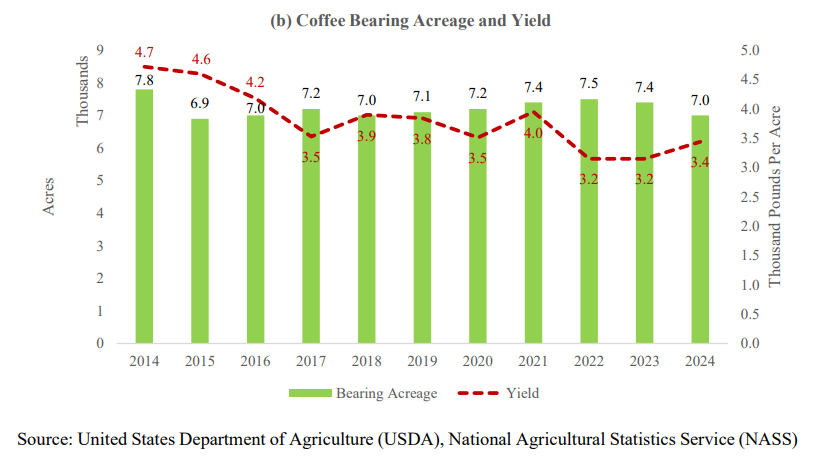
Hawaii Enterprise Budget
This graph was taken from the official Hawaii Government page. It seems to show that yield was once really solid from 2014 to 2016. It was not until 2017 that yield started to be negative compared to the bearing acreage. Because of this, it can be inferred that there has been issues with disease, or landscape issues, since Hawaii is volcano and can have unstable soil. On average in 2024, it can assumed that every acre of land produces around 0.46 lbs of coffee.
Labor Costs
Labor costs for coffee in Hawaii are exceptionally high. This is because the awkward terrain of the Kona mountains in Hawaii do not allow for harvesting machinery to function at maximum potential. This means big corporations must rely on hand picking for harvest, further increasing labor costs. According to the website, approximately 30-40% of production is labor harvesting costs. There is also a drastic decline of workers willing to pick coffee beans. This means companies must increase wages to entice more workers.
Pesticides in Coffee
According to Hawaii’s official government site, they reported that invasive pests like the Coffee Berry Borer and the Coffee Leaf Rust have contributed to declining production rates. Because of this, pesticide rates have increased significantly. However, with this being said, I could not find any information on Hawaii’s pesticide use for growing coffee beans. Even with alterative sources, it just states that every farm varies in their usage, with some being completely organic. Even the official government site states that there has been an increase, but does not give a specific number. If I had to guess, I would assume many companies are slightly organic based, or at least as natural as they can possible be.
Types of Pesticides Used
Although I was unable to find specific percentages of pesticide use, it is well known that some farmers use pesticides. From what I was able to research, there is only one or 2 main chemical pesticides, while the other pesticides are natural. The most common chemical one used for coffee is glyphosate. This is essentially a herbicide, also known as, weed killer. According to Beyond Pesticides website, glyphosate can cause cancer, neurological defects, reproductive defects, and is toxic to pretty much every animal on the planet.
Source: https://www.beyondpesticides.org/resources/pesticide-gateway?pesticideid=37
Are There GMOs of Coffee?
This is a relatively simple answer. There is currently not any genetically modified versions of coffee beans sold in the United States. There also has never been any form of genetically modified coffee beans in history either. Although, Nestle did receive a patent to produce genetically modified coffee beans in 2006.
Source: https://www.earthbeancoffee.com/blogs/life-happens-coffee-helps/gmo-coffee-doesn-t-exist
Organic Alternatives